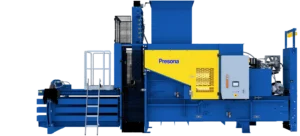
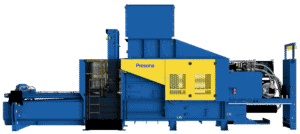
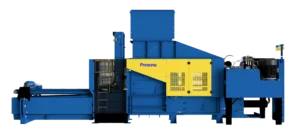
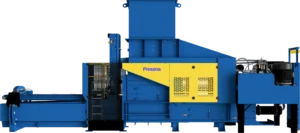
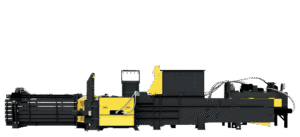
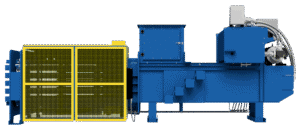
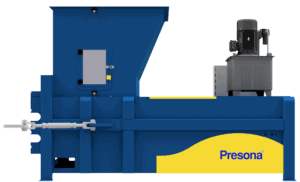
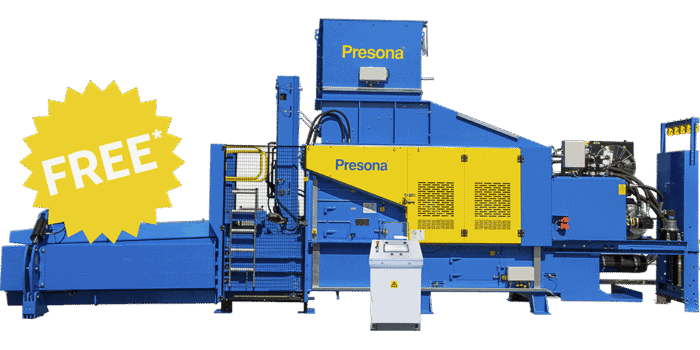
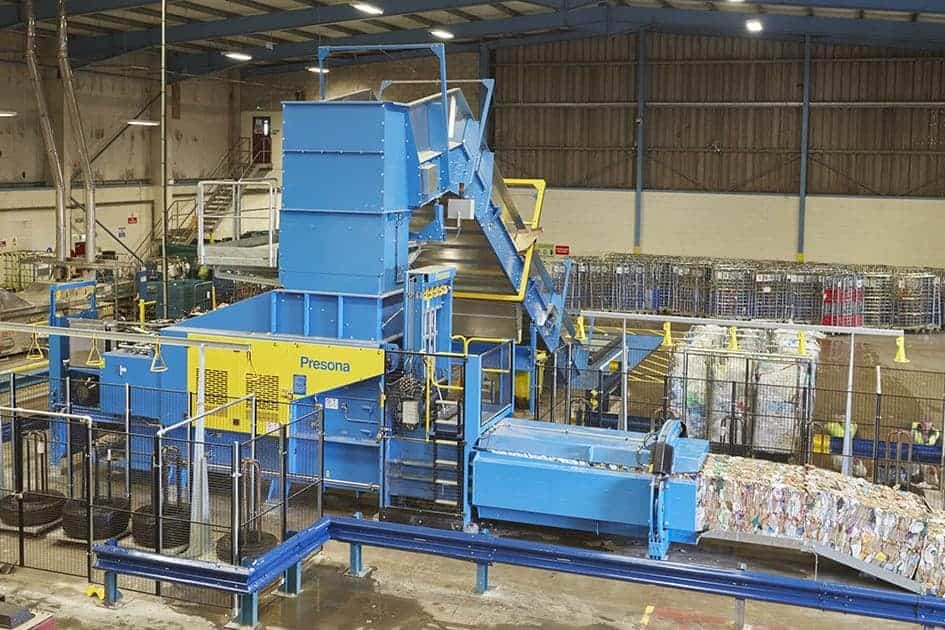
Get your Presona baler for free*!
*Low operating costs pay for the baler - click to learn how it works!
A baler is a machine that uses hydraulics, electricity, or compressed air to compress various types of materials—such as corrugated cardboard or household waste—into bales so that they take up much less space. Materials that take up less space are easier and more energy-efficient (cheaper) to handle and transport. Balers are part of the green industry.
A baler is powered by hydraulics, electricity, or compressed air to compress the material. The method used depends on the application, capacity, and size of the baler. Small balers are often powered by electricity, hydraulics, or compressed air, while larger balers are hydraulic. Presona’s balers are on the larger side and are all hydraulic, which means that oil is used to power the machines’ movements.
To put it simply, a baler operates in four steps: 1. Loading material 2. Compaction 3. Binding, and 4. Unloading the bale.
The material—for example, corrugated cardboard, which is very common—is loaded manually or automatically. Manual loading—where a person places the corrugated cardboard into the machine—is common for small balers. Larger balers, which can compress many metric tons per hour, have conveyor belts that automatically feed the baler. The conveyor belt, in turn, is often fed by a wheel loader or forklift.
Once the material enters the baler, it is compacted. Compaction involves compressing the material with great force. Small balers often compress material vertically, while larger machines compress it horizontally (from side to side). A large baler can compress corrugated cardboard at a ratio of 8:1 or 9:1, meaning the bale’s volume is just over 10 percent of the original volume. PET bottles that have first been run through a reverse vending machine (e.g., at a grocery store) can be compressed at a ratio of 10:1.
To prevent the bale from splitting apart, it is tied after compression. Small balers typically use manual binding, while larger balers almost always use automatic binding. The baling wire is annealed metal wire, plastic twine, or yarn, depending on the application, bale size, and bale density. A bale from a large baler is wrapped four to five times all around. For resilient materials such as PET, the bale is tied on all sides—a process known as cross-tying or cross-strapping.
Once the bale has been tied, it is ready. In small balers, the bale must then be manually lifted out of the machine. Large balers automatically eject the bale so it can be transported away by a forklift. Often, a type of chute, called a bale track, is used to guide the bales out of the baler in a controlled manner.
Balers can be broadly divided into two types: those used in the recycling or manufacturing industries, and those used in agriculture to compress grass, etc. Although both types are called “balers” and share the common function of compressing materials, they are very different. This article focuses on the machines used in the recycling and manufacturing industries.
Vertical balers are smaller balers used by stores and other businesses that need to compress cardboard (corrugated cardboard), plastic, and other materials. Vertical balers use electric motors, compressed air, or hydraulics to compress the material and often feature manual tying. The pressing force can be up to approximately 50 metric tons (though usually less), and the bale weight can be up to approximately 400 kg for the larger vertical machines.
Horizontal balers are also known as channel balers. They are large machines so named because they compress material horizontally within a channel. Channel balers compress the material by having the press carriage push the material against the bale that has just been completed—this bale is thus used as a wall against which to press. Channel balers can have pressing forces of up to 270 metric tons and bale weights exceeding 1,000 kg. Recycling companies are major users of horizontal balers and balers with pre-presses. (See below.) Another typical user is packaging companies.
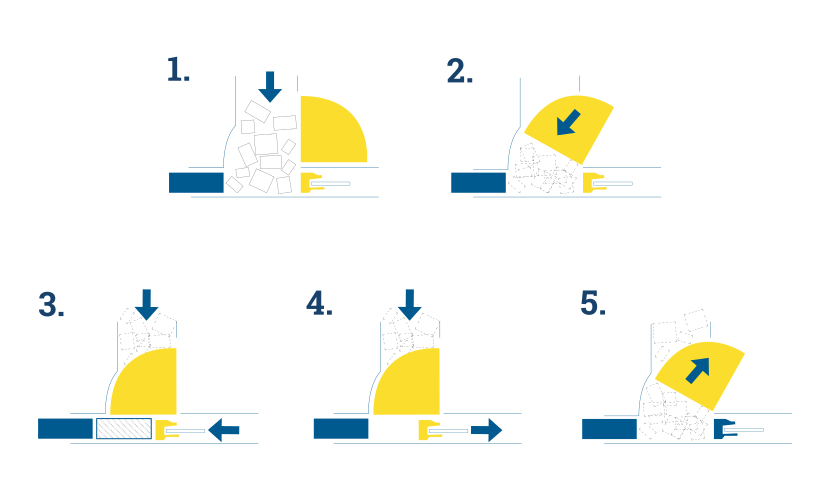
This type of baler is a kind of horizontal baler with an additional press that compresses the material vertically before the main press compresses it horizontally. This makes them particularly energy-efficient and especially well-suited for compressing materials that tend to “pop out” of the compression chamber, such as PET. Presona’s LP balers feature pre-press. See the image below, which explains how a baler with a pre-press compresses the material.
These are also large balers. Unlike a horizontal baler, a “two-ram baler” presses the material against a fixed wall, not a bale. When the bale is ready, it is ejected to the side of the baler. This type of baler is more common in North America than in Europe.
Baling presses are used in many industries and businesses. Some examples include:
These facilities compress materials such as corrugated cardboard and plastic from households, stores, and other businesses. The bales are then sold to companies that recycle the material into new corrugated cardboard and plastic. Recycling facilities use large machines such as horizontal balers and balers with pre-press units.
These use smaller balers to compress materials such as corrugated cardboard or plastic, which are then transported to recycling facilities to be re-baled into larger, more compact bales.
Distribution and logistics centers also fall into this category of users.
Here, waste material is collected to be baled and then used as the basis for new paper or cardboard.
Here, waste material is collected to be baled and then used as the basis for new packaging.
Most balers can compress many different materials, but certain types of balers may be particularly effective at compressing specific materials.
Common materials include:
Corrugated cardboard is the most common type of material compressed by balers. Paper (newspaper, office paper, printed materials, books, etc.) is also a common material. In 2023 32.2 million tonnes of paper and cardboard waste was generated in the EU.
We use a lot of plastic in society, and a large portion of it is recycled. As part of the process, the plastic is baled. Common types of plastic include PET, HDPE, and LDPE. Each person living in the EU generated 36.1 kilos of plastic packaging waste on average in 2022.
Beer and soda cans, as well as other types of aluminum and tin cans, are used and recycled.
Refuse-derived fuel (RDF) is a fuel produced from municipal waste that has been processed to burn more efficiently. RDF is burned to generate electricity or district heating. Solid recovered fuel (SRF) is a waste fuel that meets a higher quality specification than RDF. SRF has a higher calorific value than RDF.
Trim and die-cutting waste consists of paper or plastic that is cut away or punched out during the production of paper or packaging, for example. This production waste or scrap is collected at the factory—for example, via conveyor belts or pneumatic conveying systems—and transported to a baler or compactor, which compresses the material. It is then transported away to be recycled into new paper or packaging material.
Clothing, fabrics, and other textile waste are compressed so they can be transported easily and inexpensively for recycling.
A baler transforms bulky waste into compact, manageable bales—and the benefits are clear:
Learn more about Presona’s range of balers.
Four factors determine the price: the type of baler, its capacity, the level of automation, and whether it has a pre-press. A smaller vertical baler for retail stores is, of course, significantly cheaper than a channel baler with a pre-press for a recycling center. Don’t let the purchase price alone dictate your choice of baler; operating costs such as electricity, wire, service, and wear parts usually cost more than the purchase price over the machine’s lifetime. Therefore, always calculate the total cost (lifetime cost) when considering the purchase of a baler.
A compactor compresses the material directly into the container, which is then picked up with the contents still inside. A baler produces individual bales that are tied and can be stacked, stored, and sold as a separate fraction. Presona offers the compactor model K.
Start with the volume: how many metric tons (or cubic meters) do you process per week? Consider the type of material, how it’s fed into the machine (manually, via conveyor belt, or by pneumatic conveying), and how much space you have available. Retail stores and small businesses usually get by with a vertical baler, while industrial facilities and recycling centers with a steady flow of material need a horizontal baler, preferably with a pre-press.